Master Mobile Ad Monetization
App Monetization: Choosing the Right Mobile Ad Network for Unrivaled Revenue in 2025

Navigate the evolving landscape of in-app advertising: Discover the top mobile ad networks, master monetization models, and select the ideal partners to unlock exponential growth for your app in 2025.

In the fiercely competitive app economy of 2025, merely developing a great mobile application is only half the battle. The true differentiator, and often the key to long-term survival and exponential growth, lies in mastering app monetization.
For app developers and publishers, transforming engaged users into substantial revenue demands a strategic approach to in-app advertising, and at its core lies the crucial decision: choosing the right mobile ad network.
This isn’t a simple task. The landscape is crowded, fragmented, and constantly evolving with new ad formats, privacy regulations, and advanced technologies like AI and machine learning. A suboptimal choice of mobile ad network can lead to missed revenue opportunities, poor user experience, and even user churn.
Conversely, selecting the best partners can unlock unparalleled earnings, enhance user engagement, and solidify your app’s market position. This comprehensive guide will equip you with the insights, strategies, and industry knowledge needed to confidently navigate this complex terrain and secure your app’s financial success in 2025.
Tabela de conteúdos (Índice)
What are Mobile Ad Networks, and Why Are They Essential?
At its heart, what are mobile ad networks? They are digital advertising platforms that act as intermediaries, connecting app developers (publishers) with advertisers who want to display their ads within mobile applications. Think of them as massive marketplaces where app inventory (your ad space) is bought and sold.
These networks are essential because they:
- Centralize Demand: They aggregate demand from thousands of advertisers, ensuring your ad space is consistently filled.
- Automate Ad Delivery: They use sophisticated algorithms to match relevant ads to your app’s users and context, optimizing for performance.
- Simplify Management: They provide the tools and infrastructure for ad serving, tracking, and payment, simplifying what would otherwise be a complex, manual process.
- Diversify Revenue Streams: They enable various in-app ad formats and monetization models, allowing you to diversify beyond simple app purchases.
Without reliable mobile ad networks, app monetization would be a daunting, if not impossible, task for most developers.
Key Ad Formats for Mobile App Monetization: Choosing Your Arsenal
The effectiveness of your app monetization strategy heavily relies on the ad formats you choose. Each format offers distinct advantages and caters to different user experiences:
- Interstitial Ads: Full-screen ads that cover the interface of the app at natural transition points (e.g., between game levels, after completing a task). They offer high visibility and engagement but must be implemented carefully to avoid disrupting UX. They are a strong driver of app revenue.
- Rewarded Video Ads: Opt-in video ads that offer users an in-app reward (e.g., extra lives, virtual currency, premium content access) in exchange for watching a full video. Highly popular for their user-friendly, value-exchange nature, leading to high completion rates and eCPMs.
- Banner Ads: Static or animated image/text ads displayed at the top or bottom of the screen. While less intrusive, they typically have lower engagement and eCPMs compared to full-screen formats. Best for continuous, low-disruption monetization.
- Native Ads: Ads that seamlessly blend into the app’s design and content, matching its visual style and function. They offer superior user experience and engagement due to their non-disruptive nature, often leading to higher conversion rates for advertisers.
- Playable Ads: Interactive, mini-game-like ads that allow users to experience a snippet of another app’s gameplay or functionality. They are highly engaging, leading to high conversion rates for advertisers and strong eCPMs for publishers.
Strategic use of a diverse mix of these in-app ad formats is crucial for maximizing app monetization.
Mastering Monetization Models: eCPM, Fill Rate, and Beyond
Understanding the metrics that drive your app revenue is non-negotiable. Key monetization models and performance indicators include:
- eCPM (Effective Cost Per Mille): This is perhaps the most critical metric for publishers. eCPM represents your earnings per 1,000 ad impressions. It’s calculated as (Total Earnings / Total Impressions) * 1000. A higher eCPM means you’re earning more for every ad shown, indicating effective app monetization.
- Fill Rate: The percentage of ad requests that are successfully filled by an ad network. A low fill rate means you’re leaving money on the table. Aim for a high fill rate (ideally 95%+) to ensure all your ad opportunities are capitalized on.
- CPC (Cost Per Click): Earnings generated each time a user clicks on an ad. More common for banner and text ads.
- CPI (Cost Per Install) / CPA (Cost Per Action): Ad networks might pay based on user actions (e.g., app installs, sign-ups) driven by the ad. Publishers earn when a specific post-click action occurs.
- ARPU (Average Revenue Per User): Total revenue divided by the number of active users. Helps assess the overall monetization health of your app.
- LTV (Lifetime Value): The total revenue a user is expected to generate over their entire engagement with your app. Essential for long-term strategy.
A robust app monetization strategy considers these metrics in tandem to ensure both short-term gains and long-term sustainability.
Top Mobile Ad Networks: A Strategic Overview for Publishers
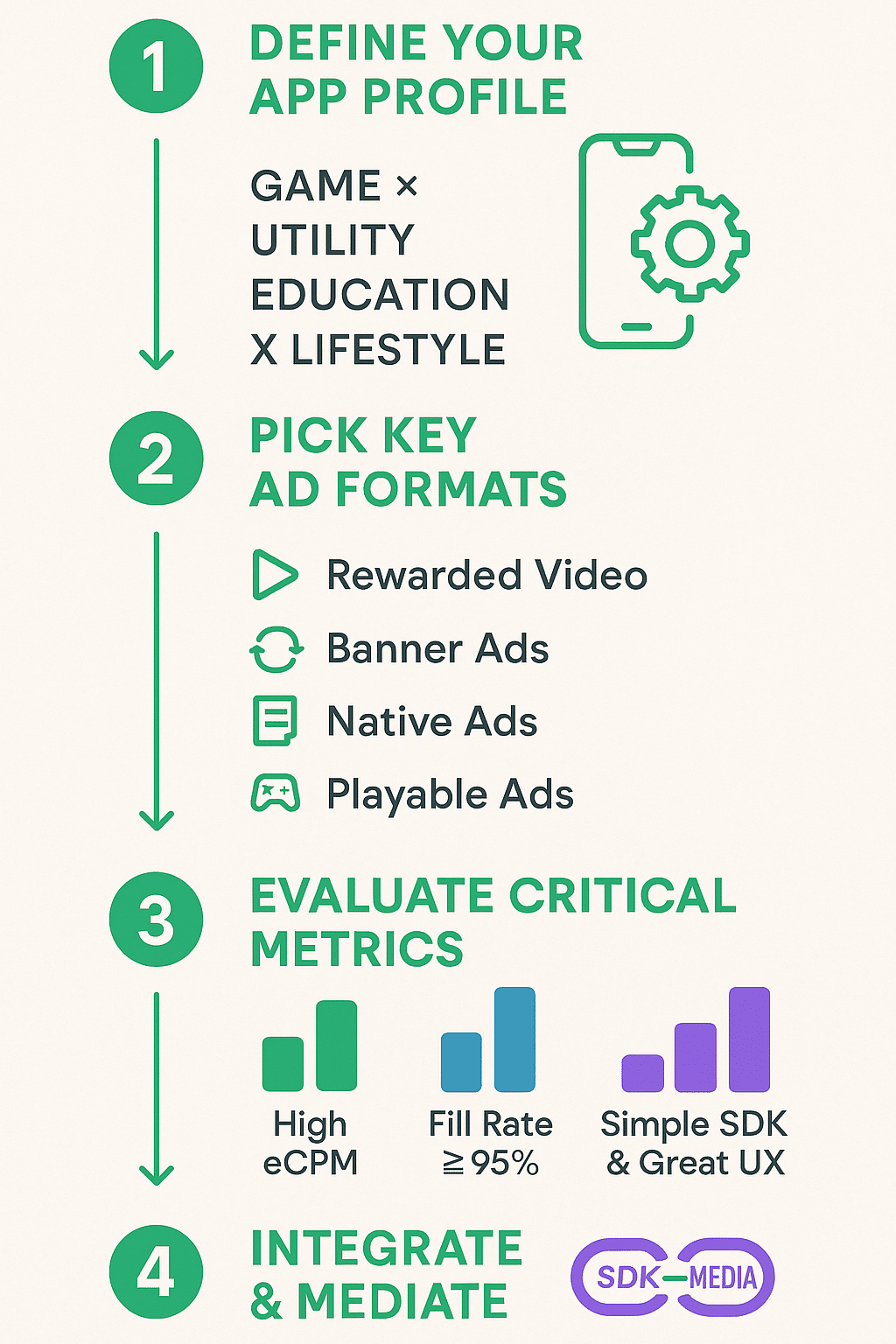
The choice of mobile ad network significantly impacts your app revenue. Here’s a strategic overview of the leading players in 2025, each with unique strengths:
- Google AdMob: As Google’s dedicated platform for mobile app advertising, AdMob is a powerhouse. It offers deep integration with Google Ads demand, a wide range of formats (including Interstitials, Rewarded Video, and Native), and robust mediation capabilities. Developers often ask, “is Google AdMob the same as Google AdSense?” While both are Google properties for monetization, AdMob focuses specifically on in-app ads, whereas AdSense is for website monetization. AdMob is a strong foundational choice, especially for Android apps.
- Meta Audience Network (formerly Facebook Audience Network): Leverages Meta’s vast user data to deliver highly targeted ads, often resulting in strong eCPMs and fill rates. It excels in bringing Facebook and Instagram demand into your app, making it particularly effective for apps with social engagement.
- Unity Ads: A dominant player in the mobile gaming industry. Unity Ads offers highly engaging video and playable ad formats, optimized for game developers. If your app is a game, Unity Ads is often a top performer for app monetization.
- AppLovin: Known for its powerful in-app advertising platform and mediation capabilities, AppLovin specializes in high-performing video ads and advanced user acquisition tools. It’s a key partner for many leading app publishers.
- ironSource: Another major player, especially strong in rewarded video and offerwall formats for gaming apps. ironSource provides a comprehensive monetization platform, including a robust mediation solution.
Beyond these giants, networks like Vungle, AdColony, and Chartboost also offer specialized strengths depending on your app’s niche and audience. The key is to select networks that align with your app’s content, user experience, and revenue goals.
Crucial Factors in Choosing the Right Mobile Ad Network for Your App
Selecting the best mobile ad network is more than just picking a name; it’s a strategic alignment. Consider these critical factors:
- Target Audience Match: Does the network specialize in reaching the demographics and geographies of your app’s users? Some networks are stronger in specific regions (e.g., Asia, North America) or for certain age groups.
- eCPM & Fill Rate Performance: These are your bread and butter. Request transparent data on their average eCPM and fill rate for apps similar to yours. A high eCPM with a low fill rate is not ideal, nor is a low eCPM with a high fill rate. You want a strong balance.
- Ad Formats Offered: Does the network support the in-app ad formats you plan to implement? If you rely heavily on rewarded video, ensure your chosen network excels in that area.
- SDK Integration & Ease of Use: How complex is their SDK to integrate? A lightweight, well-documented SDK that is easy to implement can save development time and prevent integration headaches.
- Reporting & Analytics: Look for robust, real-time reporting that provides granular insights into ad performance, user segments, and revenue streams. This data is essential for ongoing optimization of your app monetization strategy.
- User Experience & Ad Quality: The quality and relevance of ads served can significantly impact user retention. Can the network filter out undesirable ad categories or provide high-quality creatives? User experience should never be sacrificed for short-term gains.
- Support & Account Management: Especially for larger apps, dedicated account managers and responsive support are invaluable for troubleshooting, optimization, and strategy development.
- Brand Safety & Compliance: Ensure the network adheres to strict brand safety guidelines and privacy regulations (like GDPR, CCPA). Your app’s reputation is paramount.
The Power of Ad Mediation: Orchestrating Your Revenue
Once you’ve identified several strong mobile ad networks, the next step to maximizing your app revenue is ad mediation. Ad mediation is a technology that allows app developers to manage multiple ad networks from a single SDK, optimizing ad delivery by serving ads from the network that offers the highest eCPM in real-time.
How ad mediation works:
- When your app requests an ad, the mediation platform sends that request to all integrated ad networks simultaneously.
- Each network bids on the impression.
- The mediation platform then serves the ad from the network that offers the highest bid, ensuring you always get the best possible price for your ad space.
Ad mediation is crucial because it:
- Maximizes eCPM: By fostering competition among networks for every impression, it ensures you always earn the most.
- Optimizes Fill Rate: If one network can’t fill an impression, the mediation platform quickly passes the request to the next network, minimizing unsold inventory.
- Simplifies Management: Instead of managing multiple SDKs and dashboards, you handle everything through a single mediation platform.
Most top ad networks (like AdMob, ironSource, AppLovin) offer their own mediation solutions, but independent mediation platforms also exist. This layered approach is vital for advanced app monetization.
Challenges in App Monetization & How to Overcome Them
Despite the immense potential, app monetization comes with its own set of challenges that publishers must proactively address:
- Ad Fatigue: Over-serving ads or using intrusive formats can lead to users becoming fatigued, reducing engagement, or even uninstalling your app.
- Solution: Implement intelligent frequency capping, diversify ad formats, and prioritize rewarded video and native ads.
- Ad Fraud: Fraudulent impressions or clicks can significantly inflate your traffic data while depleting your actual earnings.
- Solution: Partner with reputable ad networks that employ robust fraud detection tools and monitor your reports closely for suspicious activity.
- User Experience (UX) Disruption: Poorly placed ads or frequent interruptions can degrade the user experience, leading to churn.
- Solution: Integrate ads seamlessly, respect natural breakpoints in user flow, and always prioritize UX. Balance revenue with user satisfaction.
- Privacy Regulations (GDPR, CCPA, etc.): Evolving data privacy laws require careful handling of user consent and data.
- Solution: Implement a transparent consent management platform (CMP), ensure your chosen ad networks are compliant, and stay updated on legal requirements.
- SDK Management: Managing multiple ad network SDKs can increase app size and lead to conflicts.
- Solution: Leverage a robust ad mediation platform that minimizes SDK bloat and simplifies management.
Future Trends in App Monetization (2025 Context)
The mobile ad network landscape is constantly evolving. In 2025, key trends shaping app monetization include:
- Increased Focus on User Privacy: With Apple’s App Tracking Transparency (ATT) and Google’s Privacy Sandbox initiatives, contextual targeting and first-party data will become even more crucial. Publishers need to build strong relationships with users for consent.
- AI and Machine Learning: AI will continue to revolutionize ad delivery, optimization, and user segmentation, making app monetization strategies even more sophisticated and data-driven.
- Hybrid Monetization Models: Combining ads with in-app purchases (IAPs) and subscriptions will become the norm, offering users multiple ways to engage and spend, maximizing app revenue.
- Connected TV (CTV) and Gaming: As gaming continues its explosive growth and CTV gains traction, new ad formats and opportunities will emerge, expanding the scope of mobile ad networks.
Staying ahead of these trends is vital for publishers aiming to secure and grow their app monetization in 2025 and beyond.
Frequently Asked Questions (FAQ) about App Monetization and Mobile Ad Networks
What are mobile ad networks, and how do they help app developers?
Mobile ad networks are platforms that connect app developers (publishers) with advertisers to display ads within mobile applications. They help developers monetize their apps by centralizing demand from various advertisers, automating ad delivery, simplifying management, and diversifying revenue streams.
What is eCPM, and why is it important for app monetization?
eCPM (Effective Cost Per Mille) represents your earnings per 1,000 ad impressions. It’s a key metric for app monetization because a higher eCPM means you are earning more for every ad shown. It’s calculated as (Total Earnings / Total Impressions) * 1000.
What are the main types of in-app ad formats?
The main in-app ad formats include Interstitial Ads (full-screen at transition points), Rewarded Video Ads (opt-in video with in-app rewards), Banner Ads (static ads at screen edges), Native Ads (blend seamlessly with app design), and Playable Ads (interactive mini-games).
Is Google AdMob the same as Google AdSense?
No, Google AdMob is not the same as Google AdSense, although both are Google monetization platforms. AdSense is primarily for website monetization (web display ads), while AdMob is exclusively for mobile app monetization (in-app advertising).
What is ad mediation, and how does it maximize app revenue?
Ad mediation is a technology that allows app developers to manage multiple mobile ad networks from a single SDK. It maximizes app revenue by optimizing ad delivery to serve ads from the network offering the highest eCPM in real-time, ensuring optimal earnings for every impression.
What factors should I consider when choosing the best mobile ad network for my app?
When choosing the best mobile ad network, consider: target audience match, eCPM and fill rate performance, supported ad formats, SDK integration ease, reporting and analytics capabilities, ad quality and user experience impact, support level, and compliance with privacy regulations.
How can I deal with ad fraud in my app monetization strategy?
To combat ad fraud in app monetization, partner with reputable mobile ad networks that employ robust fraud detection tools. Regularly monitor your app’s ad performance reports for suspicious activity (e.g., unusually high clicks without corresponding installs or engagement) and report any discrepancies.
How important is user experience (UX) when implementing in-app ads?
User experience (UX) is extremely important. Poorly placed ads, excessive frequency, or intrusive formats can lead to ad fatigue and degrade UX, increasing uninstall rates. Prioritize native and rewarded video formats, implement frequency capping, and ensure ads blend seamlessly with the app’s natural flow to maintain user retention and long-term app revenue.
What are some common challenges in app monetization?
Common challenges in app monetization include ad fatigue leading to churn, combating ad fraud, managing user experience disruption from ads, navigating complex privacy regulations (GDPR, CCPA), and dealing with the complexity of integrating and managing multiple SDKs from various mobile ad networks.
What are future trends shaping mobile app monetization in 2025?
Key future trends for app monetization in 2025 include an increased focus on user privacy (e.g., Apple’s ATT, Google’s Privacy Sandbox), continued revolution by AI and machine learning in ad optimization, the rise of hybrid monetization models (combining ads with IAPs/subscriptions), and new opportunities emerging from Connected TV (CTV) and gaming growth.
Conclusion
In the dynamic app economy of 2025, mastering app monetization is the ultimate differentiator for publishers. It’s not enough to simply integrate ads; success hinges on strategically choosing the right mobile ad network and optimizing every facet of your in-app advertising strategy. From understanding diverse ad formats and crucial metrics like eCPM and fill rate to leveraging the power of ad mediation, every decision directly impacts your app revenue.
The journey to peak app monetization requires a partner who understands these complexities deeply. Grumft offers the expertise and proprietary solutions to help you navigate this intricate landscape, ensuring your app not only retains users but also achieves unparalleled financial success. By optimizing your ad strategy with a focus on user experience and cutting-edge technology, you transform your app into a powerhouse of sustainable profit.
Ready to see these results in action today? Monetize your website or app with Grumft. Plus, explore our proprietary solutions – like GPush – with zero monthly fees and an ad revshare model, designed to supercharge your app monetization and build a truly engaged user base.
References
- Google Ads
- Google AdMob
- Meta Audience Network
- Unity Ads
- AppLovin
- ironSource
- Google Developers – Privacy Sandbox
- IAB (Interactive Advertising Bureau)
- App Tracking Transparency (ATT) – Apple Developer
🚀 Join the Monetization Revolution!
Follow Grumft on LinkedIn for exclusive SEO, engagement and revenue insights delivered straight to your feed.
Follow Grumft on LinkedInLeia também:

LTV vs CAC: A Matemática da Sobrevivência Digital

Ad Mediation is Broken. The Unified Auction is How You Fix Your Revenue.

Análise do Ciclo de Vida do Assinante: Guia de Engajamento e Receita para Publishers


Autor(a):
Fernanda Calandro
Online desde 1997, sou uma profissional de marketing e conteúdo com formação robusta em marketing. Especializada em simplificar temas complexos através das minhas redações, eu facilito a conexão entre publishers e especialistas, promovendo um entendimento claro e acessível.


